Introduction
Washington, D.C. is in the middle of the most consequential civic calendar it has seen in fifty years. DC250 – the city’s sprawling commemoration of the United States Semiquincentennial — has already brought record crowds to the National Mall this year, and the biggest tentpole moments are still ahead. For any executive, government official, diplomat, or business traveler with meetings to make, this isn’t background noise. It’s a logistics problem with real financial consequences.
If you’ve flown into Reagan National or Dulles this year and tried to get downtown on a day when a parade, festival, or federal ceremony was underway, you already know what’s coming. Multiply that by dozens of remaining signature events between now and the end of 2026, and it becomes clear why DC 250 executive transportation has become one of the most searched logistics terms among corporate travel managers and executive assistants planning trips to the capital.
This guide explains what DC250 actually is, why it’s straining the city’s transportation network unlike any prior anniversary, and what separates a smooth executive trip from a stressful one during this stretch of Washington’s calendar.
What Is DC250?
DC250 is the Washington, D.C. component of America250 — the nationwide, congressionally chartered commemoration of the 250th anniversary of the Declaration of Independence, signed July 4, 1776. The effort is coordinated at the federal level by the U.S. Semiquincentennial Commission, working alongside the nonprofit America250 Foundation, the White House, and the District government, with additional programming from Virginia’s VA250 and Maryland’s parallel commemoration.
Because Washington houses the National Archives, the Capitol, the White House, and the Smithsonian’s founding-era collections, it has become the undisputed center of gravity for the celebration — not a single day, but a year-long sequence of federal ceremonies, museum openings, concerts, and civic gatherings.
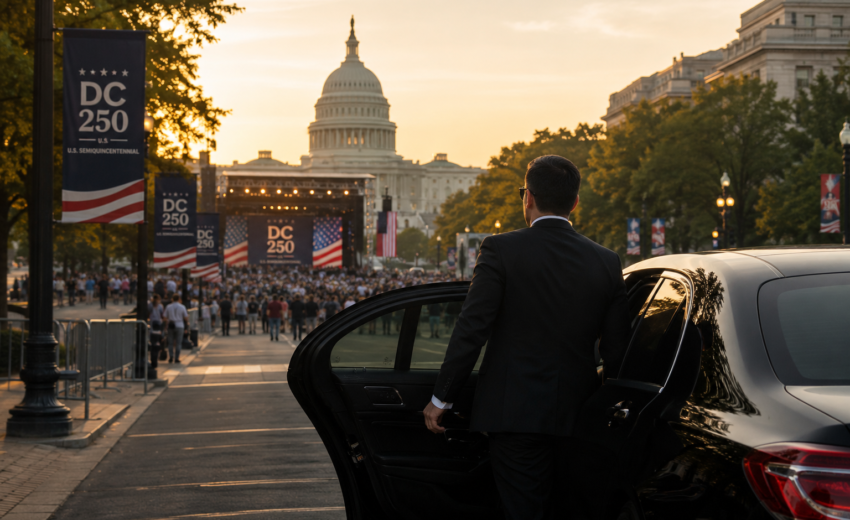
The scale is already visible in what’s happened so far in 2026: the National Memorial Day Parade returned to Constitution Avenue in May, the Great American State Fair transformed the Mall between the Capitol and the Washington Monument for sixteen days in late June and early July, the Giant National Capital BBQ Battle drew crowds to Pennsylvania Avenue, and the Library of Congress opened its “Declaration’s Promise” exhibit featuring Jefferson’s rough draft of the Declaration alongside Lincoln’s Gettysburg Address.
The remaining months bring more of the same intensity. The Freedom 250 Grand Prix — the first-ever NTT INDYCAR SERIES race staged on the National Mall — is scheduled for August 22–23, running a temporary street circuit past the Washington Monument and U.S. Capitol. DC JazzFest follows in September with programming built around America’s next 250 years. The Smithsonian’s National Museum of African American History and Culture marks its own 10th anniversary alongside the national milestone in late September, and the Hirshhorn Sculpture Garden is set to reopen after a multi-year revitalization in the fall.
For executives, the takeaway is simple: this isn’t a single weekend to route around. It’s a year where “normal” traffic patterns in the District can’t be assumed on any given date.
Why Transportation Gets Difficult During DC250
Washington’s core downtown grid was never designed to absorb the volume DC250 is generating, and several factors compound the problem:
Heavy, unpredictable congestion. Signature events on the National Mall routinely bring street closures on Constitution and Independence Avenues, Pennsylvania Avenue, and the surrounding federal core, sometimes with only days of public notice.
Elevated security posture. Events involving federal officials, foreign dignitaries, or large public gatherings bring credentialing checkpoints, vehicle screening zones, and hardened perimeters reminiscent of presidential inauguration security — all of which slow or reroute ground traffic near the Mall, Capitol Hill, and the White House.
Parking scarcity. Downtown parking, already limited, disappears entirely near event footprints, pushing drivers into longer walks or improvised drop-off points.
Airport strain. Reagan National and Dulles both see spikes in arrivals timed to marquee events, which extends curbside wait times and rideshare queues exactly when executives have the least flexibility in their schedules.
Hotel-zone congestion. Hotels near the Mall and Capitol Hill see compounding traffic from event attendees, tour groups, and official motorcades converging on the same blocks.
Last-mile unpredictability. Even when the origin and destination are both accessible, the final few blocks into a hotel, embassy, or federal building can be closed with little warning, something a fixed-route rideshare driver is often not equipped to navigate around in real time.
None of these problems are new to Washington. What’s new in 2026 is their frequency and their overlap — a corporate traveler can no longer assume that “next Tuesday” will look like any ordinary Tuesday downtown.
Why Executives Need Private Transportation During DC250
For a business traveler, a delayed rideshare or a driver unfamiliar with a sudden closure isn’t just an inconvenience — it’s a missed meeting, a blown connection, or a compromised first impression with a client or counterpart. Private executive transportation addresses this in several concrete ways:
- Time protection. A dedicated chauffeur builds buffer into the route before you ever leave the curb, rather than reacting to closures in real time.
- Privacy and confidentiality. Calls, briefing materials, and sensitive conversations stay contained in a private vehicle rather than a shared or public one.
- Security awareness. Professional chauffeurs operating in Washington during high-security periods understand credentialing zones, screening checkpoints, and which streets are realistically passable on a given day.
- Reliability under pressure. A single missed pickup during a closure-heavy week can cascade into a missed flight; a professional service builds contingency into every leg.
- Productivity en route. Time in the vehicle becomes usable work time rather than navigation stress.
- Real-time routing. Experienced local chauffeurs adjust routes dynamically as closures are announced, rather than depending solely on a mapping app that hasn’t caught up to a fresh road closure.
- Airport coordination. Flight tracking and curbside meet-and-greet service remove the uncertainty of matching an arrival to ground transportation during a high-traffic period.
Nationwide Limo Continuity: One Standard of Service, Every Leg of the Trip
Most executive trips during DC250 don’t begin or end in Washington — they’re one stop in a broader itinerary that might include New York, Chicago, or a home-market office before and after. This is where nationwide chauffeured continuity matters most.
A single point of coordination for the entire trip means:
- Airport pickup at Reagan National, Dulles, or BWI, matched to real-time flight status.
- Hotel transfer with a chauffeur who already knows which entrances and drop-off points are accessible given current closures.
- Meeting-to-meeting transport across the District, Northern Virginia, and Maryland without re-briefing a new driver at each stop.
- Multiple event venues — from Capitol Hill briefings to National Mall functions — handled by a chauffeur who has already scouted the access points.
- Corporate dinners and evening functions with reliable, on-time return service.
- Interstate continuity, so the same standard of vehicle, professionalism, and booking process follows the executive to the next city on the itinerary.
- Return airport service timed against real-world departure conditions, not a generic estimate.
This continuity is the difference between a trip that feels seamless and one that requires the traveler to re-solve the same logistics problem in every city.
Executive Travel Tips for DC250
- Book early — especially around signature events. Vehicle availability tightens dramatically in the days surrounding the Freedom 250 Grand Prix, DC JazzFest, and any newly announced federal ceremony.
- Build in buffer time. Add 30–60 minutes beyond a typical estimate for any trip that crosses the federal core during an event window.
- Monitor the event calendar. DC250 programming is still being finalized and updated throughout the year; confirm the schedule close to your travel dates.
- Reserve airport transportation in advance, particularly for arrivals timed close to a major event’s start.
- Avoid peak arrival windows where possible by shifting flight times even an hour or two.
- Coordinate with hotel concierge teams, who often have the latest word on which entrances and streets are accessible.
- Plan alternate pickup and drop-off locations in case a primary entrance falls inside a security perimeter on a given day.
Why a Professional Chauffeur Matters More Than Ever
The value of an experienced chauffeur goes beyond simply driving. During a year like this one, it comes down to:
- Local route expertise built from operating in Washington through prior high-security, high-traffic periods.
- Security awareness, including familiarity with credential checks and screening zones near federal buildings.
- Active flight monitoring, so airport pickups adjust automatically to delays.
- Schedule flexibility, with the ability to hold, reroute, or reposition as an itinerary shifts.
- Executive-level service standards — discretion, punctuality, and professional presentation appropriate for clients, officials, or diplomats.
- Professional etiquette suited to sensitive business and government settings.
Comparison: Taxi vs. Rideshare vs. Rental Car vs. Executive Limo
Factor | Taxi | Rideshare | Rental Car | Executive Limo |
Reliability during closures | Low | Low–Medium | Medium | High |
Privacy | Low | Low | Medium | High |
Business productivity | Low | Low | Low | High |
Cost predictability | Medium | Low (surge pricing) | Medium | High |
Airport pickup coordination | Low | Medium | Low | High |
Waiting time during peak events | High | High | N/A (self-drive) | Low |
Professionalism/presentation | Low–Medium | Low–Medium | N/A | High |
Access near event/security zones | Low | Low | Low | High |
Executive Travel Checklist for DC250
- Confirm your trip dates against the current DC250 and America250 event calendar
- Reserve airport-to-hotel executive transportation in advance
- Reserve return airport transportation at the time of booking, not day-of
- Share your full meeting itinerary with your chauffeur or transportation coordinator
- Identify backup pickup/drop-off points near each destination
- Add buffer time to any leg crossing the National Mall, Capitol Hill, or White House perimeter
- Confirm hotel entrance accessibility with the concierge close to arrival
- For multi-city trips, confirm continuity of service in each subsequent city
Conclusion
Washington, D.C. is in the middle of a year that historians will reference for decades, and for executives, that means the busiest, most unpredictable travel conditions the city has produced in a generation. Between the events already behind us in 2026 and the signature moments still ahead — the Freedom 250 Grand Prix, DC JazzFest, and the string of Smithsonian anniversary programming through the fall — the margin for logistics error keeps shrinking.
Executives who plan their transportation early, rather than reacting to closures and checkpoints in real time, protect what matters most: their schedule, their privacy, and their ability to show up prepared. A professional chauffeur service that understands DC’s security posture and can coordinate seamlessly across airports, hotels, corporate travel and event venues — and follow that same standard into the next city on the itinerary — turns a logistically difficult season into a non-issue.
If your schedule brings you to Washington during any part of the DC250 calendar, reserve your DC250 executive transportation well in advance of your trip. Availability tightens fastest around marquee events, and early booking is the simplest way to guarantee a seamless experience during the nation’s historic 250th anniversary year.
Frequently Asked Questions
1. What is DC250?
DC250 is Washington, D.C.’s portion of America250, the nationwide commemoration of the 250th anniversary of the Declaration of Independence. It spans a year of federal ceremonies, museum exhibits, concerts, and civic events centered on the National Mall and the District’s monumental core.
2. What is the best executive transportation for DC250?
A dedicated executive chauffeur service is generally the most reliable option, since it combines real-time route adjustment, airport flight tracking, and familiarity with security checkpoints — advantages that taxis, rideshare, and rental cars typically can’t match during high-closure periods.
3. How busy will Washington, D.C. be during the 250th anniversary?
Very busy, and unevenly so. Rather than a single peak weekend, DC250 spreads major events across the year, so congestion, checkpoints, and parking shortages can appear on short notice around any signature program.
4. Should I reserve transportation before arriving?
Yes. Vehicle availability tightens considerably around major DC250 events, and last-minute bookings are far more likely to run into limited options or higher rates.
5. Which airports should executives use?
Reagan National, Dulles, and BWI all serve the D.C. region, and each can see event-driven surges in arrivals. Confirming ground transportation in advance, regardless of airport, avoids curbside delays.